

Article
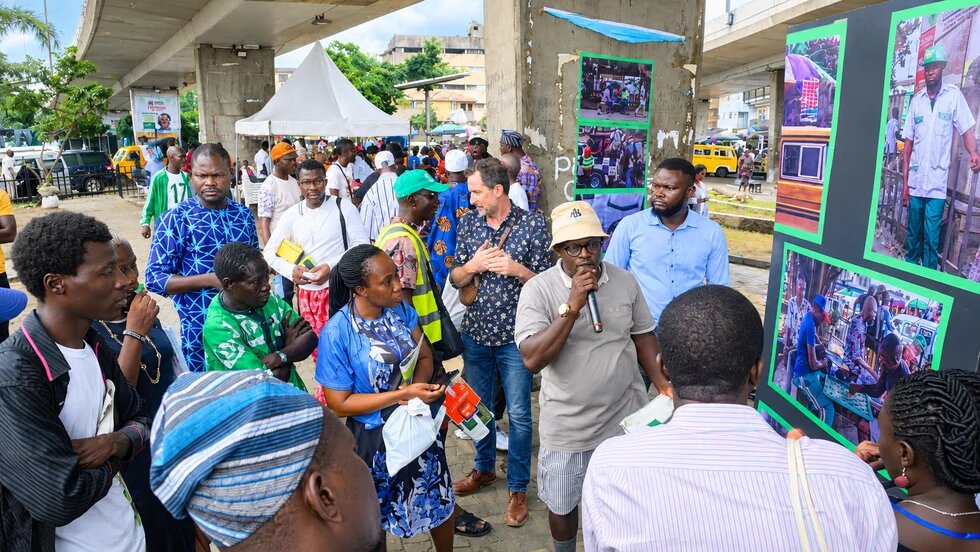
On 20th June 2026, a photographic installation opened at Obalende Motor Park in Lagos in the middle of the park itself, between bridge pillars, showcasing members of the National Union of Road Transport Workers (NURTW) and their daily work. The installation in the midst of the bus drivers, commuters, and community was meant as a moment for self-representation and reflection on how bus drivers and conductors contribute to the making of Lagos. The exhibition drew on 8 years of ethnographic research on the Union by Laurent Fourchard from Sciences Po's Centre de Recherches Internationales (CERI), Paris, and on two years of photography in Lagos' motor parks, especially Oshodi and Obalende, by Andrew Esiebo.

Since its creation in 1978, the National Union of Road Transport Workers (NURTW) has shaped Lagos' transport system. While it has allegedly become the largest union in Nigeria, its growth has also come with an image of criminalization and widespread stories of misconduct. At the same time, no observer of transport systems would be able to explain the way Lagos works without acknowledging a certain order resulting from the power of the NURTW, and even social regulation as well as violence containment.
The “Oshodi” motor park is where the NURTW story is rooted. Oshodi follows a pattern: it morphed progressively from a railway hub into a danfo hub. The Lagos-Ibadan line, built in 1898, turned it into a colonial transport node. What followed was not planned; the oil boom of the 1970s brought waves of migrants who filled the rail corridors with markets, workshops, and eventually motor parks. When Governor Fashola's demolition crews arrived in 2014 a build a new station for the Bus Rapid Transit (BRT) system and a monorail, the railway tracks had been entirely buried beneath the bustle. Infrastructure arrives, the population absorbs it, transforms it, overflows it in a permanent negotiation between the city that is designed and the city that is lived. BRT has not totally displaced the union's regulated transport as initially envisioned. Instead, BRT and the NURTW work side by side. The exhibition at Oshodi is meant to place the work at its historical heart.
Obalende is a central node in the life of Lagos. Obalende carries its history in its name: Ibi ti Oba lé wà dé, the place where the king drove us away. Built at the edge of a colonial segregation device, it sits today at the exact crossing point between the popular city of the mainland and the affluent neighbourhoods of Victoria Island and Ikoyi. These worlds intersect here without necessarily seeing each other. Hundreds of thousands of people move through it every day. The research and the exhibition explore everything that lives here: union regulation, the street economy, and informal order. As We See Am installs itself at that crossing.
The situations portrayed in the pictures sparked conversations about concrete dynamics: the role of the union as a regulator between users and drivers, especially when it comes to security and tariffs, and the routines pacing their work on a daily basis. The pictures showed different divisions, different routes, negotiations with other entities such as LASMA, or occupation of spaces neglected by the state.
Watch the Video: As We See Am – (Un)making Clichés of Lagos' Transport Union | Photos and films by: Samuel Okechukwu
For most visitors, it was essentially a big unveiling of how the union operates. For almost all of them, they never had a direct engagement with them when it comes to speaking about their work. In fact, the notion of work became more associated with the union during the event than the notion of crime. The audience dived into clarifications about what that work entails and what changes are being made to shift the still-dominant perception of violence. The audience's main questions, as they reacted to the photographs and to the union members' comments on the pictures, focused on the union's accountability: what do they intend to do about people being scared, and about people not understanding how prices can be controlled? All questions were answered with attention and willingness to offer perspective, while acknowledging the necessity for change.
In essence, the exhibition created a rare moment for qualitative dialogue, providing a structure on the day to hold the confrontation without it collapsing into accusation or reassurance, because trust was at the core of the relationship between artist Andrew Esiebo and researcher Laurent Fourchard. The public space did not display a conclusion, it hosted a construction. It made the gap very palpable between what happens in a city at a very large scale and how Lagosians and scholars can miss the structural mechanisms of their own surroundings. The exhibition served as a safe space to create and share new knowledge.
About the author:
Miora Ranaivoarinosy is a French-Malagasy curator and cultural producer based in Berlin, whose practice unfolds between Berlin, Lagos and Paris (Undisciplined Practice). After more than twenty years supporting social enterprises through an incubator and leadership programs in social innovation, she now develops curatorial projects with artists and researchers at the intersection of arts, sciences and social engagement. As We See Am installation, community event, and public engagement activities, conceived with photographer Andrew Esiebo and researcher Laurent Fourchard (CERI Sciences Po/CNRS), are part of this inquiry into public space as a site of collective knowledge production. She is currently preparing a doctoral project on pan-African imaginaries.